
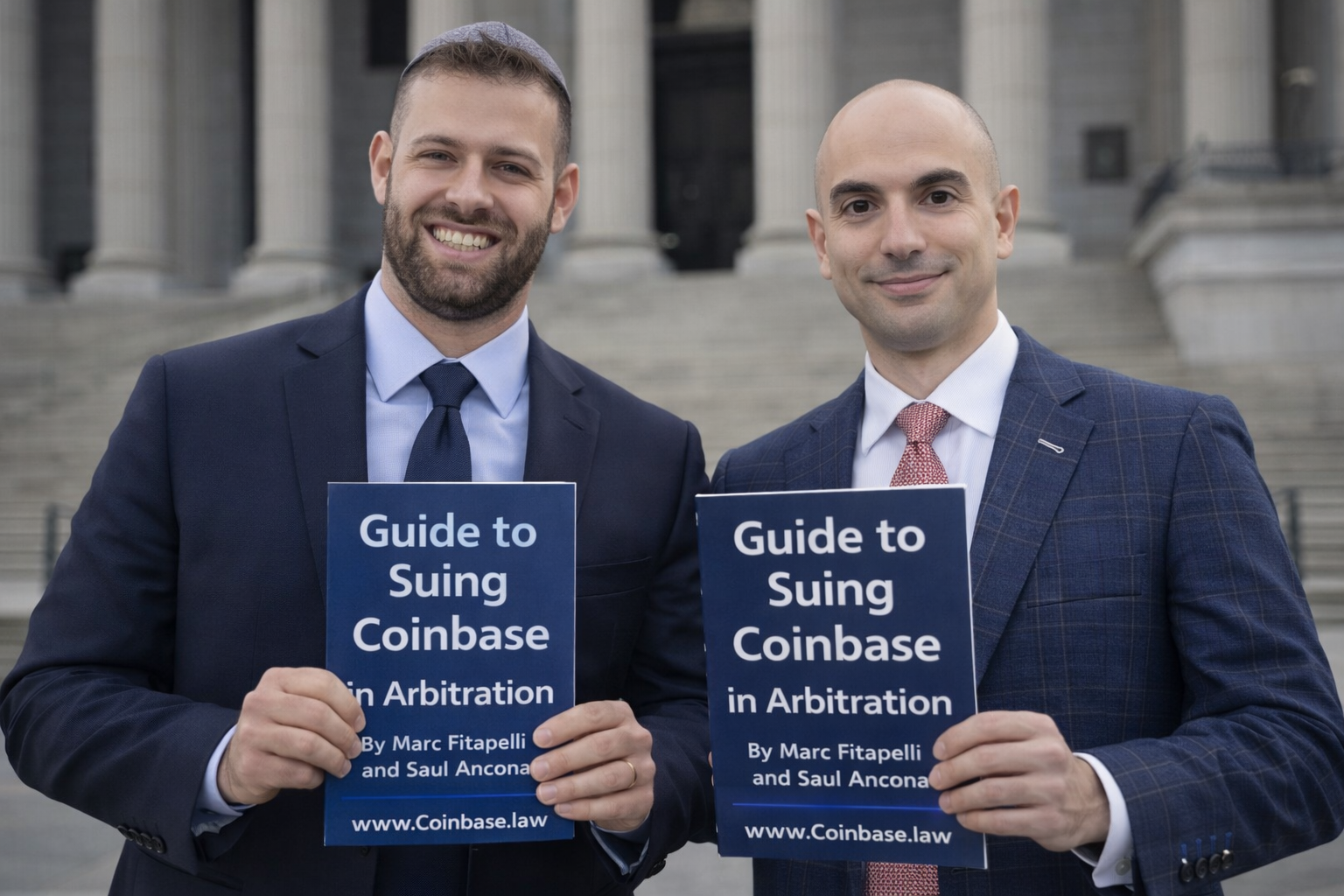
This guide is intended to provide general, educational information to Coinbase customers who are considering bringing individual claims against Coinbase, Inc. It is not legal advice and does not create an attorney-client relationship. Rather, it is designed to explain the procedural framework that governs most Coinbase disputes and to identify structural features of that process that can materially affect a consumer’s ability to present a claim fairly. Coinbase disputes are not governed by ordinary civil procedure. Instead, they are resolved through private arbitration pursuant to a contractual agreement between Coinbase and its customers. Understanding that framework before initiating a claim is essential.
For most Coinbase customers, arbitration is not optional. Coinbase’s Terms of Service contain a mandatory arbitration clause that courts and arbitrators routinely enforce. As a result, traditional lawsuits in state or federal court are generally barred, and disputes must instead be resolved through binding arbitration administered by the American Arbitration Association under its Consumer Arbitration Rules. Because arbitration is the default—and in most cases the only legally available forum—this guide focuses primarily on how that process works and how consumers can navigate it effectively.
In limited circumstances, yes. Coinbase’s Terms of Service allow customers to bring claims in small claims court, provided the claim falls within the jurisdictional and monetary limits of the consumer’s local court. These limits vary by state and sometimes by county. Small claims courts are designed to be accessible and informal, with relaxed evidentiary rules, minimal discovery, and expedited proceedings. For claims that clearly fall within those limits, small claims court may offer an efficient and more familiar resolution mechanism. However, small claims courts are also subject to statutory damage caps and limited remedial authority, and in some jurisdictions Coinbase may still seek to enforce its arbitration agreement.
If your claim qualifies for small claims court under your local jurisdiction’s limits, it is often worth considering that option first. Small claims proceedings take place within the public judicial system, are overseen by a judge, and provide more traditional forms of judicial oversight than private arbitration. That said, many Coinbase disputes involve losses that exceed small claims limits, in which case arbitration is unavoidable.
Because the enforceability of mandatory arbitration provisions is well settled under federal law. The United States Supreme Court has repeatedly upheld arbitration clauses in consumer contracts under the Federal Arbitration Act, and lower courts routinely compel arbitration when a valid arbitration agreement exists. In practical terms, this means that consumers face an extremely high legal barrier to avoiding arbitration once they have agreed to it. While challenges are sometimes raised, they are rarely successful.
Arbitration is a private adjudicatory process that takes place outside the court system. Instead of a judge or jury, a neutral arbitrator decides the dispute. Arbitration differs from court litigation in several significant ways. There is no jury, discovery is limited, procedural discretion rests largely with the arbitrator, and there is generally no meaningful right to appeal an adverse decision. Arbitration awards are final and binding, subject only to extremely narrow judicial review.
Coinbase’s Terms of Service contain a choice-of-law provision selecting California law to govern disputes arising out of or relating to a customer’s account. Arbitrators routinely enforce such provisions, particularly where the chosen jurisdiction has a substantial relationship to the parties or the transaction. As a result, California substantive law generally governs the interpretation of the agreement and the evaluation of state-law claims, even for consumers who reside outside California.
Depending on the facts, consumers may assert claims under California’s consumer-protection statutes, including the Unfair Competition Law, which prohibits unlawful, unfair, or fraudulent business practices and provides for equitable relief and restitution. In appropriate cases, consumers who qualify as elders may also have claims under California’s Elder Abuse and Dependent Adult Civil Protection Act, which provides heightened protections and remedies for financial exploitation. The availability of these claims depends on the specific facts of the case.
Yes. Federal statutes apply nationwide and are not displaced by state choice-of-law provisions. In appropriate circumstances, consumers may assert claims under federal laws such as the Electronic Fund Transfer Act, which governs certain unauthorized electronic fund transfers and establishes consumer protections, disclosure obligations, and liability limitations. Federal claims may be asserted concurrently with state-law claims in arbitration.
Although California law governs by contract, consumers who reside in other states should also consider whether their home state’s consumer-protection statutes apply to the conduct at issue. Many such statutes apply where in-state residents are harmed, even if the defendant is located elsewhere. Whether a non-California statute applies depends on the statute’s language and the factual connection to the consumer’s home state.
No. While Coinbase’s User Agreement contains provisions that broadly seek to limit or disclaim liability, such clauses are not absolute. Under California and federal law, contractual liability waivers generally cannot eliminate responsibility for gross negligence, willful or reckless misconduct, or violations of statutory duties. They also cannot override consumer-protection statutes or waive rights created to protect the public. Arbitrators evaluate these provisions in context, based on the claims asserted and the facts presented.
The arbitrator decides nearly every aspect of the case. The arbitrator determines whether discovery will be permitted, what evidence will be admitted, how the hearing will be conducted, how legal standards will be applied, and ultimately who prevails. Arbitration offers no meaningful appellate review on the merits, and arbitration awards are rarely vacated. As a result, the arbitrator’s decision is effectively final.
Because the arbitrator serves as both fact-finder and decision-maker, and because there is no meaningful appeal. Arbitrators are not randomly assigned and do not serve for life or fixed terms. They are selected through a party-driven process in which each side has the opportunity to evaluate and strike proposed candidates. For consumers, this selection process represents one of the few meaningful procedural safeguards available in arbitration.
After Coinbase responds to the arbitration demand, the American Arbitration Association provides the parties with a list of proposed arbitrators. Each party may strike arbitrators and, in some instances, rank remaining candidates. If all proposed arbitrators are struck, AAA issues a new list and repeats the process. This “rank-and-strike” mechanism may occur multiple times, and no arbitrator will be appointed without surviving the strike process.
Arbitrators are required to disclose their professional backgrounds, prior engagements, and potential conflicts. Consumers often consider striking arbitrators whose experience is heavily oriented toward representing financial institutions, defending corporate parties, practicing predominantly commercial arbitration, working at large national or international law firms, or previously arbitrating Coinbase matters. These considerations reflect the reality that professional experience shapes perspective, not an accusation of bias.
Before filing, consumers should assemble and organize a complete factual record, including applicable versions of Coinbase’s Terms of Service, transaction histories, account access records, screenshots, communications with Coinbase support, and any law-enforcement or IC3 reports. Arbitrators do not investigate disputes independently. They rely entirely on what the parties present. Clear organization and chronological presentation enhance credibility and comprehension.
Coinbase commonly responds with a general denial that broadly denies liability without addressing specific factual allegations. This practice is procedurally permissible and does not reflect a determination on the merits. However, consumers may request that the arbitrator require Coinbase to clarify its defenses so that the case can be managed fairly and efficiently.
Discovery is intentionally limited under the AAA Consumer Arbitration Rules. Arbitrators often default to minimal discovery in the interest of efficiency. However, discovery is not categorically prohibited. Arbitrators retain discretion to permit narrowly tailored discovery where necessary to ensure fundamental fairness, particularly in cases involving technical complexity or information asymmetry.
The arbitration hearing is the central evidentiary stage of the case. Both parties present testimony and documentary evidence. Consumers may testify, respond to questions, and cross-examine Coinbase’s witnesses. Arbitrators evaluate credibility, consistency, and evidentiary support. Clear, factual explanation is far more important than legal argument.
The arbitration hearing is the central evidentiary stage of the case. Both parties present testimony and documentary evidence. Consumers may testify, respond to questions, and cross-examine Coinbase’s witnesses. Arbitrators evaluate credibility, consistency, and evidentiary support. Clear, factual explanation is far more important than legal argument.
After the hearing concludes, the arbitrator issues a written decision, often referred to as an arbitration award. Under the AAA Consumer Arbitration Rules, the consumer’s financial responsibility is generally limited to the filing fee, while Coinbase bears the remaining administrative and arbitrator costs. The award is final and binding, and judicial review is extremely limited.